

TL; DR:
Patient registration, check-in, and clinical intake are different steps. This guide explains what each involves, who is responsible, and how clinics can avoid repeated paperwork.
- Registration, check-in, and clinical intake serve different purposes. Registration links the right patient record to the right appointment. Check-in confirms the patient has arrived. Clinical intake gathers the reason for the visit, relevant history, medicines, allergies, and reports.
- One form can serve both purposes without making patients repeat themselves. Reuse details already collected at booking and make it clear which fields reception checks and which answers the clinical team reviews.
- Make the handoff visible. A patient can be checked in while their clinical details are still pending review. Keep the original answers and documents available to the clinician, and flag missing information rather than treating it as confirmed.
- Use intake to prepare for the consultation, not replace it. In the blog’s knee pain example, reception links an old prescription to the visit, while the clinician checks what the patient actually takes. Having a document on file does not mean its details are current or verified.
A patient arrives at a clinic for the first time. Reception confirms their identity and checks them in for the appointment. Meanwhile, the patient has an old prescription and a recent report that the doctor has not seen. Registration is complete, but the patient’s clinical information is still awaiting review.
Patient registration establishes the patient’s identity and appointment record. Clinical intake collects information the doctor needs to prepare for the consultation. Patients register to identify the patient and to connect them to the correct visit. During clinical intake, the reason for the visit, relevant history, medicines taken, allergies, or records are collected to prepare for the consultation.
These two aspects can occur in the same form, at the same desk, or before the patient’s arrival. The key is to understand who is responsible for the information on each, and what has yet to be verified. Let’s look at that distinction from the bookings to first consultation in an outpatient clinic.
What Are Patient Registration and Patient Intake?
Some clinics use ‘patient intake’ to describe everything that happens before a consultation, including registration and check-in. Registration primarily handles administrative details, while clinical intake gathers relevant health information before or at the beginning of a consultation. You don’t need to alter the name of the process in your clinic. This is helpful to differentiate when assigning tasks.
Patient registration connects the right person to the right visit.
Registration is the creation of the patient’s record and matching the record with the correct appointment. If dealing with a new patient, reception could ask for a name, date of birth, or age, and verify the appointment information, making a record of the appointment. When a patient comes back to the office, an employee can find the previous record and verify if there have been any changes.
Depending on the clinic, registration may also involve payment or insurance information (where applicable) and verification that any necessary administrative documents are filled out. Some of this can occur at the time of scheduling the appointment. Check-in (confirmation of patient arrival) may occur later. It is possible for a patient to be pre-registered without being checked in.
A US healthcare-system study published in Applied Clinical Informatics found duplicate electronic health records for 2.9% of the 1,185,752 patients examined. This is not an India-specific benchmark, but it highlights why accurate patient matching matters. The researchers also identified an association between missing demographic information and duplicate records. This illustrates why patient registration should include careful record matching and identity verification rather than automatically creating a new record for every visit.
Source: Epidemiology of Patient Record Duplication, PubMed Central
Clinical intake prepares the information the doctor needs
Clinical Intake gathers what the patient wants to talk about and pertinent background information, including the start time of the concern, medicines, known medicine allergies or reactions, and reports from the visit. This could be written by the patient, completed electronically, or with assistance from clinic personnel. Depending on the clinic’s workflow, a nurse or another designated clinical team member may review the information before the doctor’s consultation. During clinical intake, ask the patient about the onset of the concern, changes, and previous treatments.
The test is simple. Most answers that identify the patient, schedule the patient, or check the patient belong to registration. Typically, if it is helpful to the clinical team to better understand or evaluate the patient’s concern, it would be considered clinical intake. Some details are used for both purposes – but no patient should need to provide the same information twice just because two teams are doing the same.
How Do Registration and Intake Differ in Fields and Staff Responsibilities?
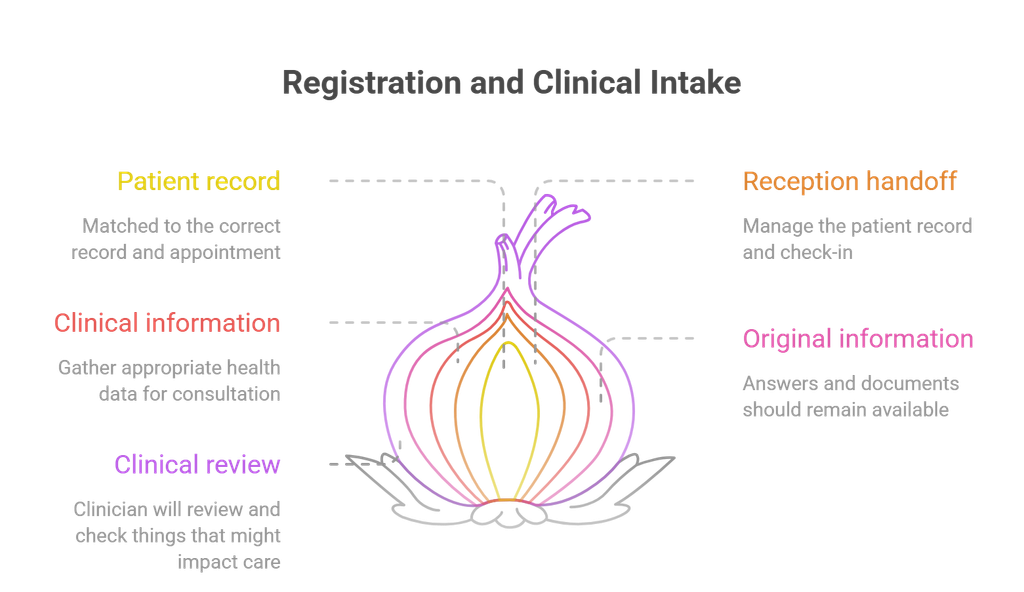
It may be convenient for patients to use a combined form. The clinic should still have a good understanding of the answers that are required for reception, the clinical team, and those that should be checked behind the scenes. The table below is a practical division for an outpatient visit.
| Clinic task | Patient registration | Clinical patient intake |
| Primary purpose | Ensure the patient is matched to the correct record and appointment. | Gather appropriate health data for consultation |
| Typical fields | Identification: Name, Date of Birth/Age, Contact No., Clinic ID, Appointment Information | Purpose for visit, history of symptoms, history, current medications, allergies |
| Supporting documents | Securing confirmation of booking, billing & insurance documentation (when required) | Any pertinent prescriptions, test reports, referral notes, previous clinical records |
| Usual owner | Reception or registration staff | Patient/carer provides information, which is reviewed by the nominated clinical team. |
| Typical timing | Prior to booking, upon arrival or when checking in | When arriving, at check-in or before the doctor starts the consultation |
| What gets checked | It is important that identity, contact details, and record/appointment match. | Relevant clinical information, source documents and discrepancies |
| What completion means | The visit is associated with the proper patient record | Information submitted and can be reviewed – gaps are clearly marked |
A patient may be registered and checked in even when clinical intake details are pending review. Track these as separate workflow states; a ‘form complete’ label does not mean a clinician has verified the information.
Give reception a clear handoff
Reception can open forms on schedule, retrieve forms for the correct appointment, or hand over a document to the correct team-no need for staff to read/understand the document or judge if the medical response is complete. An allergy may be left unanswered if left blank, such as by the reception, for example. They should not change it to “no known allergies” to clear an incomplete field.
If the person performs multiple functions in a small clinic, make the handoff visible but not necessarily between two departments. “Checked in” can be distinguished from “clinical details pending review” by either a paper folder or an appointment note or a software status. That provides the doctor with a stronger signal than simply a “form complete” label.
Give the clinical team the original information.
It can be helpful to provide a brief overview so the doctor can quickly review the information about the visit, but the answers and documents should remain available to the doctor and other authorised staff who may require them. If the patient states they are still taking a medicine that is mentioned in an old prescription, the clinical team can check against the dated prescription and verify the medicine they take at present. The summary should clearly flag any information that has not yet been verified.
DocForUs supports clinical intake by organising patient-reported information and medical records into a structured summary for the doctor to review. It helps to create a comprehensive history and report from the patient and presents it in a structured format before the doctor’s appointment. In this workflow, reception will still manage the patient record and check-in, and the clinician will review and check things that might impact care.
How Do Registration and Intake Work During a First Clinic Visit?
Suggested workflow: Booking and record match → Registration and check-in → Clinical intake → Clinician review.
Clinical intake may take place before check-in. This sequence shows responsibilities, not a mandatory order.
Let’s imagine a first visit to a GP’s surgery in Pune. The patient is visiting this clinic for the first time because of persistent knee pain, having previously consulted another doctor. They have a previous prescription and a report, but they can’t remember the name of the medicine they have taken recently. Here are some scenarios in which these two processes can be complementary, but not require the patient to begin again at each turn.
1. Reception creates the booking and checks for an existing record
The patient calls for an appointment. Reception records the information required to make the booking, verifies if the clinic has a record of them, and sets up the booking time. There isn’t a need to ask for a detailed symptom history to complete the booking in Reception.
2. The patient shares relevant information before arriving
The clinic provides a brief form to be filled at the time of the appointment, which is also included with the appointment confirmation, and the patient is informed that they may complete it at reception also. The patient says that the pain has been persistent for some time; they have taken a painkiller, but don’t know the name, and they will take the prescription to the doctor and explain the problem. It is not necessary for the patient to guess, as the form records what the patient knows.
3. Reception checks the patient in and links the documents to the visit
The patient’s information is checked on arrival and registered as checked in. The patient gives over documentation – these are processed by the team based on the clinic’s process. Registration and check-in are complete, but the clinical information still requires review. The report is now available for clinical review, but does not imply that anyone has read it.
4. The clinician verifies the details that matter
The Clinician displays the patient’s description, the available documents, and the medication details that remain unresolved. They validate the primary concern and inquire about the specific medications being taken. If the old prescription is appropriate, they consider it in its context instead of assuming that it reflects actual use. The consultation note can then differentiate between what was reported, what was documented, and what was verified.
The same process is followed if the patient does not complete the form. The clinical team takes the necessary history on the visit, and Reception is responsible for identification and check-in. Offer paper forms or assisted form completion when needed. Do not delay necessary clinical assessment while waiting for paperwork.
If your clinic is looking to enhance this process, begin by going over the fields of your existing form. In each one, ask who uses the answer, when they would use it, and what would happen if it was not available. That exercise can reveal a place where patients are being asked to repeat themselves and a place where a clinical question is reduced to a checkbox in an administrative process.
Where DocForUs Fits in the Patient Intake Workflow
Patient registration ensures that the right patient is connected to the right appointment. Clinical intake goes a step further by collecting information doctors need to prepare for the consultation.
DocForUs helps clinics organise patient-submitted medical information into structured pre-consultation summaries, allowing doctors to review relevant details before meeting the patient.
With DocForUs, clinics can:
- Prepare doctors before consultations: Bring together the patient’s reason for visiting, symptoms, medical history, and relevant reports in an organised overview.
- Support structured clinical intake: Help doctors review patient-reported information without relying entirely on paper forms or scattered documents.
- Identify details requiring verification: Make it easier to recognise missing information, unclear medication histories, and other details that need discussion during the appointment.
- Keep administrative and clinical responsibilities separate: Allow reception teams to manage registration and check-in while doctors focus on reviewing clinical information.
- Support informed consultations: Give doctors useful patient context while keeping medical verification, assessment, and treatment decisions clinician-led.
DocForUs complements existing patient registration workflows by supporting the clinical intake process rather than replacing appointment booking or reception management systems.
Conclusion
Patient registration and patient intake are connected but serve different purposes in a clinic. Registration identifies the patient, creates or updates their record, and connects them to the correct appointment. Clinical intake collects the symptoms, medical history, medications, allergies, and supporting records doctors need to review.
A well-organised clinic workflow ensures that patients do not have to repeatedly provide the same information and that reception staff are not responsible for making clinical judgements.
For clinics adopting digital workflows, DocForUs can help organise patient-submitted information into structured pre-consultation summaries, giving doctors relevant context before appointments.
Ultimately, the goal is not simply to complete registration and intake forms. It is to ensure that the right information reaches the right healthcare professional at the right stage, supporting more organised consultations while keeping clinical decisions in the doctor’s hands.
Frequently Asked Questions
What is the difference between patient registration and patient intake?
Registration establishes or updates a patient’s record and associates it with the correct appointment. Clinical patient intake collects the data for the consultation including complaints and medical history of the patient, current medications, allergies, reports, etc. Registration is an administrative process that helps maintain accurate patient records and associate them with the correct visit. Clinical intake can get the care team ready.
Are patient registration and check-in the same thing?
Not exactly. When the patient registers, the information required to create or validate information for their patient and visit record is gathered. Check-in verifies that the patient has arrived for the appointment. Most of the work for registration can be done prior to the visit and confirmed at reception at the clinic.
Can a clinic use one form for registration and intake?
Yes. One form may be utilized for both registration and intake. Apply information already gathered at booking, and ensure that unclear answers are simple to document, and guide clinical information to the appropriate staff members. One form does not equate to one person verification of all answers.
Who should review clinical intake information?
The initial information can be given by the patient or carer and reception will help to obtain and correlate the information to the correct appointment. A member of the clinical staff can be designated to review health information in their capacity. The treating clinician should confirm information which may impact assessment or therapy.
Does patient intake always happen after registration?
No. A clinical intake form may be completed before arrival, during check-in or just before the consultation. Registration and clinical intake details may also be collected in a combined form. The order may be different. Linking that information to the appropriate patient/visit and making it available to the clinical team for review is what is important.