

Patient History-Taking Format for OPD Clinics
TL; DR:
This OPD history-taking format helps clinics record the patient’s chief complaint, symptom history, medications, allergies, and relevant medical background. It also identifies details the clinician needs to verify.
- Start with the patient’s main concern. Record why the patient came in, in their own words. For a first visit, collect relevant history and available records. For a follow-up, focus on what has changed since the last visit.
- Use one template for paper or digital intake. The printable format covers the symptom timeline, medical and surgical history, current medicines, allergies, and investigations. It also leaves space for clinician notes and corrections.
- Record where the information came from and flag what’s uncertain. Note whether it came from the patient, a caregiver, or a previous record. Use labels such as “dose not confirmed” or “allergy status unknown” instead of treating a blank field as a negative answer.
- Separate pre-visit intake from clinician verification. The doctor confirms the patient’s priority, clarifies the symptom timeline, checks current medicines and reported reactions, and reviews original reports when they may affect care.
A patient says they are taking ‘the same tablet as last time’, but the prescription they brought is six months old. Another leaves the allergy field blank because they are unsure whether a previous medicine reaction counts as an allergy. A structured history form should capture these gaps so the doctor knows what to clarify during the consultation.
The form should include the chief complaint, history of the patient’s symptoms, medical and surgical history, medications, allergies, and records, if any, for a routine outpatient department (OPD) visit. It should also indicate where the information came from and what remains to be verified.
The template below distinguishes between the information that the patient/clinic staff can already document before the consultation and what the doctor should confirm during the consultation. This can be copied into a clinic document, printed out for paper-based OPDs, or modified into a digital intake form.
What Should an OPD Clinic Record Before the Visit?
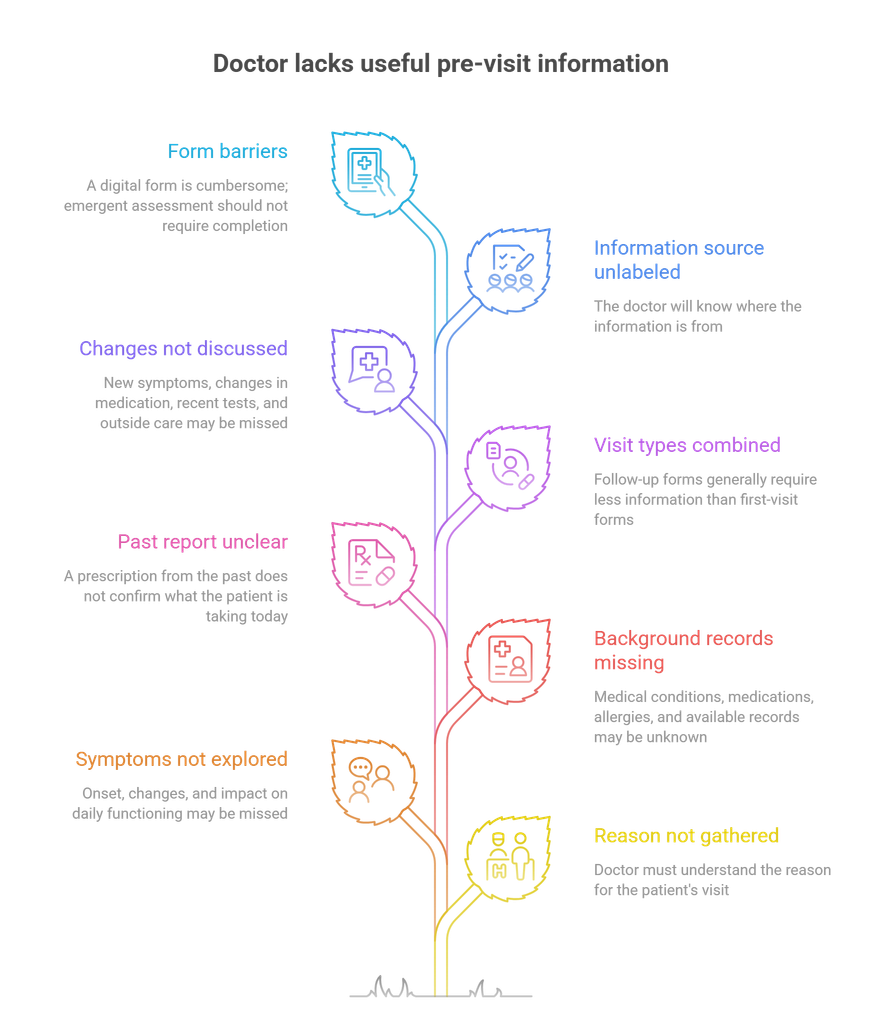
Gather details before the consultation that will assist the doctor in understanding the reason for the patient’s visit and what records may be relevant. This provides the physician with a valuable point of departure, rather than requiring the patient to respond to a lengthy clinical interview on a form.
Start with the reason for the visit.
Ask an easy question like, “What would you like the doctor to help you with today?” and allow the patient to respond in their own words. If a patient returns for a routine follow-up visit, there could be something new they are concerned about that isn’t known from the appointment label.
If their visit is for symptoms, inquire about onset of symptoms, changes in symptoms, and impact on daily functioning. If the patient has more than one concern, ask the patient to share the other concerns and identify which is their priority to discuss.
Collect relevant background and available records.
Inquire about any medical conditions, surgeries or hospitalizations, any current medications or known allergies or previous reactions. If a patient cannot recall the name or dosage of a medicine, write “not known” and have the patient bring the medicine prescription or medicine list or packaging if possible.
If the patient provides a report, document the report and the date of the report. Blood test report dated 4 November, copy available” is better than “blood tests done.” An older prescription shows what was prescribed at that time, but it does not confirm which medicines the patient is currently taking.
Keep first visits and follow-ups separate.
A follow-up form will generally require less information than a first-visit form. When meeting with patients who have come back, discuss how things may have changed since their last visit. Discuss any new symptoms, changes in medication, any recent tests, and care received outside of your practice. Verify information that is relevant and exists already rather than asking the patient to repeat information.
Note the source of the information as well. If a parent, family member, or caregiver has filled in the form, label it so the doctor will know where the information is from. Provide assistance or paper forms if a digital form is cumbersome, and don’t require the completion of a form for emergent assessment.
The US Agency for Healthcare Research and Quality (AHRQ) states, “The diagnostic pathway begins with a chief complaint from a patient.” This reinforces why an OPD history-taking format should begin with the patient’s own description of their concern before moving to detailed medical history questions.
Source: AHRQ: Probability and the Diagnostic Pathway
A Printable OPD Patient History Taking Format
This template is a starting point for routine outpatient visits. Adapt the questions to your specialty and keep space for the doctor to add or correct information. Fields that are blank or uncertain should remain visibly unconfirmed.
| Section | What to record |
| Patient and visit details | Name or clinic ID __________ · Age or date of birth __________ · Visit date __________ · First visit / Follow-up |
| Source of history | Patient / Parent or caregiver / Previous record / Other __________ · Relationship to patient, if relevant __________ |
| Main concern | In the patient’s own words ________________________________________ |
| History of the current problem | Onset __________ · Duration and frequency __________ · Changes over time __________ · Associated symptoms __________ · What makes it better or worse __________ · Effect on daily activities __________ |
| Previous care for this concern | Consultations, treatments tried, and reported response ________________________________________ |
| Relevant medical and surgical history | Existing diagnoses, significant illnesses, procedures, or hospital stays ________________________________________ |
| Current medicines | Name __________ · Dose __________ · Frequency __________ · What the patient actually takes __________ · Details to confirm __________ |
| Allergies and adverse reactions | Substance or medicine __________ · Reported reaction __________ · Status reported / Denied by patient / Not known |
| Relevant family and social history | Family conditions, occupation, exposures, tobacco or alcohol use, or other details relevant to the visit ________________________________________ |
| Relevant review of systems / other symptom screening | Additional symptoms relevant to the presentation ________________________________________ |
| Available investigations and records | Report or record __________ · Date __________ · Copy available / Patient-reported only |
| Changes since last visit | New concerns, medication changes, tests, or care received elsewhere ________________________________________ |
| Clinician verification and additions | Details confirmed, discrepancies resolved, and questions still open ________________________________________ |
| Clinician and review time | Name or initials __________ · Date and time __________ |
Keep the physical examination, assessment, and plan in separate sections of the OPD note. That way, the reader can tell which information came from the patient’s history and which findings or decisions were documented by the clinician.
This template covers the history portion of an outpatient consultation, not the complete OPD record. Depending on the visit, the full clinical note may also include vital signs, physical examination findings, assessment, investigations, treatment and follow-up instructions.
For a more complete history, the clinician can document symptom severity, location, timing, associated symptoms and previous self-treatment where relevant. Specialty-specific questions should be included only when they help assess the presenting concern.
For clinics collecting information before a consultation, DocForUs can organise patient-reported concerns, history and shared medical records into a structured pre-consultation summary for the doctor to review. The summary can serve as a starting point for the conversation, with any missing or contradictory details checked during the visit.
What Should the Doctor Verify During the Consultation?
The form becomes most useful when the doctor reviews the responses and clarifies details that could affect clinical assessment or treatment. Check available information and use the consultation to check information that might impact assessment or treatment.
Confirm the patient’s priority and symptom timeline.
First, ensure the history is for the appropriate patient and visit. Then ask if the concern on the form remains the concern that the patient is most interested in talking about. When time is an important factor, clarify such words as “recently,” “occasionally,” or “getting worse.” For example, ‘pain for a month’ might mean continuous pain, intermittent episodes or pain that started a month ago but has since resolved. The doctor should clarify the timing and pattern. The form may appear to be complete without the clinical history.
Check what the patient actually takes and what reaction they had
When applicable, check the current list of medications against the list of medications available or packaging. Inquire about what the patient is taking currently, discontinued, or modified medications since the last visit. Write down differences that remain instead of forward-copying an older list.
If there’s an allergy or an adverse reaction, verify the medication or substance and solicit a description of the reaction from the patient. If the allergy field is blank, record the allergy status as unknown. Do not document ‘no known allergies’ unless the patient or an appropriate source has explicitly confirmed this.
Check original reports and leave uncertainty visible
When a report could affect care, the clinician should review the original report when available rather than relying solely on the patient’s recollection or an automated summary. Verify the report date and, if applicable, the result and the unit. If two sources don’t agree, write down the differences and what remains to be verified.
For instance, a patient who has been coming into the clinic regularly says he is using the same blood pressure medication as before, but the prescription he uploaded is a few months old. The pre-visit history may read as shown: Patient reports taking a blood pressure medicine; current name and dose NOT confirmed. After speaking with the patient and reviewing the available information, the doctor can update the medication history or document which details remain unverified. The format has served its purpose either way, as it brought the uncertainty into the light.
A well-structured history helps the doctor understand the patient’s concerns, relevant background and information that still requires clarification. The purpose of this is to provide a structure to the consultation and allow the patient’s story and the clinician’s judgement to come into play.
How DocForUs Supports OPD History Preparation
A structured patient history is useful when doctors can review relevant information before the consultation without treating patient-submitted details as clinically verified.
DocForUs helps clinics organise pre-consultation patient information into a structured summary, giving doctors a clearer starting point for each appointment.
With DocForUs, clinics can:
- Organise patient information before the visit: Bring together patient-reported symptoms, medical history, medications, and other relevant details for review.
- Support more focused consultations: Help doctors understand the patient’s main concerns before beginning the clinical discussion.
- Identify information requiring clarification: Make it easier to review missing, incomplete, or potentially inconsistent details during the consultation.
- Support doctor-led decision-making: Keep clinical verification, interpretation, and treatment decisions in the hands of the healthcare professional.
DocForUs is designed to support the consultation process, not replace clinical history-taking or medical judgement.
Conclusion
A standard patient history-taking format helps OPD clinics collect information consistently while keeping patient-reported details separate from clinically verified findings.
Whether clinics use a printable template or digital patient intake, the essential information remains the same: the patient’s chief complaint, symptom history, medical and surgical background, current medications, allergies, and relevant investigations.
The most important step is ensuring that doctors review and verify information that could influence patient care.
Digital solutions like DocForUs can support this workflow by organising patient-submitted information into a structured pre-consultation summary. This allows doctors to begin with relevant context while retaining responsibility for confirming the patient’s history and making clinical decisions.
Frequently Asked Questions
What is the standard patient history-taking format for an OPD clinic?
A good OPD format comprises patient and visit information, problem statement, history of the problem, history of medical/surgical conditions, previous investigations, allergies, and current medications. Include family and social history as applicable; provide room for the clinician to verify/correct key history/background.
What is the difference between the chief complaint and the history of present illness?
The chief complaint is the patient’s primary reason for coming to the doctor’s office and should be written as the patient would say it. The history of the present illness will detail the history of the concern since it arose: onset, pattern, progression, associated symptoms, and any care previously sought for the concern.
Should first visits and follow-ups use the same OPD history form?
They may use the same main parts but should include follow-up forms with the changes since the last visit. Inquire about any new worries, changes in medications, and recent tests or consultations. When applicable, revise existing information rather than have patients re-enter information.
How should missing information be recorded in a patient history?
Please use specific terms like “dose not confirmed,” “report not available,” or “allergy status unknown.” These labels distinguish information that is missing, uncertain, patient-reported or verified by the clinician. Document a refusal separately when relevant.
Can patients fill in an OPD history form before the appointment?
Yes. Before the appointment, patients have the ability to give their reason for coming to the office, symptoms, medical history, medicines, and available reports on paper or digitally. The doctor should confirm any information that may impact the care and ask any additional questions during the consultation.