
TL; DR:
Use this eight-question patient intake template to collect essential information before a first clinic visit without asking patients to guess at medicines, allergies or medical details.
- Keep registration separate from clinical questions. Collect only the details needed to match the patient to the appointment. Then let patients explain, in their own words, what they want to discuss with the doctor.
- Use the eight-question template on paper or online. It covers contact details, the reason for the visit, relevant medical history, medicines and supplements, allergies or reactions, available records, and any help the patient needs.
- Let patients say when they’re unsure. Options like “Not sure” and “I’ll bring the packaging” are more useful than forcing an answer. A blank allergy or medication field should stay marked as unknown, not recorded as “none.”
- Decide when to collect the form and who checks it. Send it with the appointment confirmation for scheduled visits and offer paper or assisted intake for walk-ins. Reception checks registration details, while the clinician reviews information that could affect care.
A new patient’s name and phone number are completed, and the medication section is left blank. Are there no medicines for them, have they forgotten their names, or are they bringing a prescription? Without clear answer choices, the clinic cannot tell whether the patient takes no medicines, has forgotten their names or plans to bring a prescription. Patients have a means of communicating to you which one it is if you have a form that is well designed.
The information necessary to register the patient, to gain insight into why they are visiting, and to indicate what the doctor should verify should be obtained from them on a first-visit intake form. It doesn’t have to include all their health records. A short form, with the answers No, Not sure, and Will bring details, is more useful than a long form that gives patients the chance to guess.
The following is an 8-question template for regular outpatient visits. Clinics can print it off to use in their clinic or copy it into a document for use online. The guide also includes information on when, by whom, and how to proceed when the answers are not provided.
What Belongs on a New Patient Intake Form?
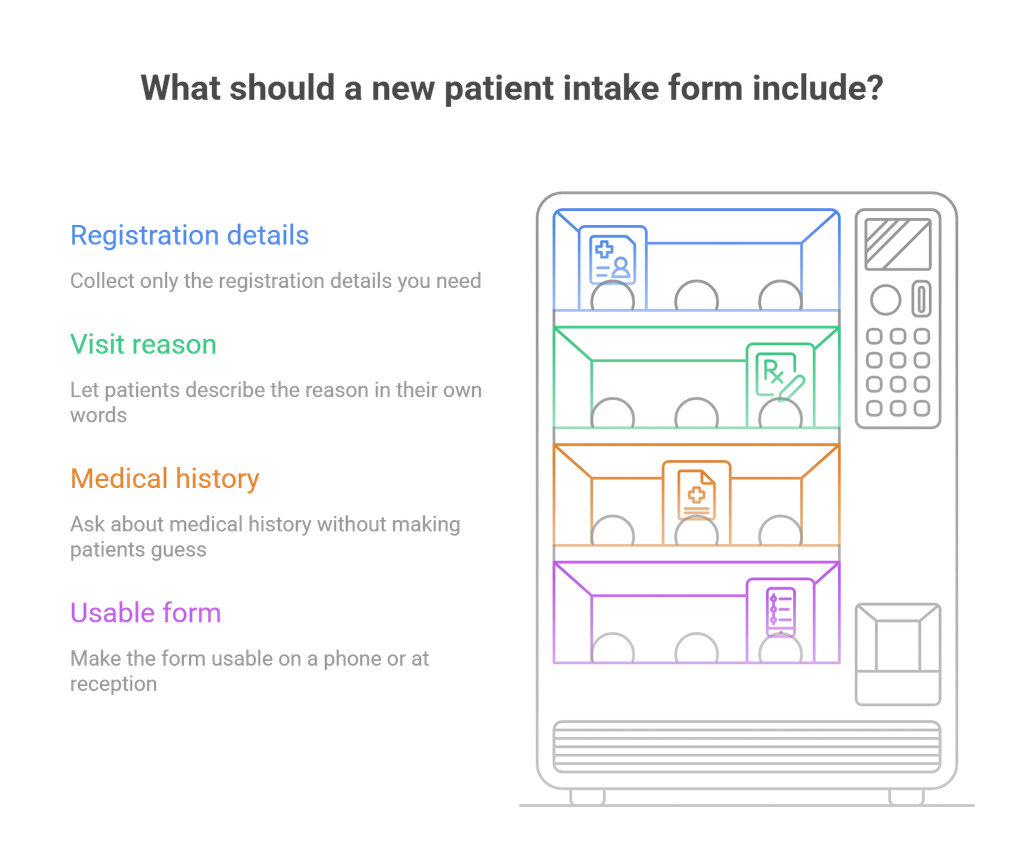
There are two purposes of a new patient intake form. It provides the reception with enough information to match up the patient to the right appointment, and it provides the starting point for the conversation with the patient and the doctor. Separate those jobs when determining what to ask. Reception might request date of birth/contact number confirmation, but clinical answers should be available to those who require them at the visit.
Collect only the registration details you need
Have the patient’s name, date of birth (or age), and a number that the clinic can call to schedule an appointment for the patient. If these details were already collected during booking, ask the patient to confirm them rather than enter them again. Staff may take this information from the walk-in at the time of check-in.
If the form is completed by a parent, caregiver, or family member, indicate the parent’s or caregiver’s relationship to the patient. The form should show who provided the information, whether it was the patient, a caregiver or a clinician. If the clinic requires questions about billing or insurance, place them in another section aside from the visit questions.
Let patients describe the reason for the visit in their own words
The booking may be for a new symptom, a second opinion, or a review of a report, and may be referred to as a general consultation booking. Inquire about the issues the patient wants to talk about and listen to them. If they say they have a symptom, ask them to let you know when it began and if it has changed.
This field shouldn’t be too difficult to answer without medical jargon. “What would you like to talk to the doctor about?” is more useful to more patients than “What is your main problem?” It also leaves room for answering the question “I want to understand a test result,” without the need to answer a symptom checklist that does not apply to them.
Ask about medical history without making patients guess
Ensure that the first visit clinical questions are limited to the relevant conditions, surgeries/hospital admissions, medicines, known allergies/medical reactions, and records of the visit. Inquire about any medications the patient is taking (including non-prescription drugs and supplements). Allow them to write in the dose and frequency, if they know, or take the package or a list to the appointment.
Provide separate answer options for ‘No’ and ‘Not sure’ so patients are not forced to guess. “No” response to a known allergies question means that someone has given information. If one doesn’t fill it in, one hasn’t. If the patient indicates a reaction, provide space for the patient to tell you what occurred, not asking if it was an allergic reaction.
The US Agency for Healthcare Research and Quality (AHRQ) offers guidance on making primary-care materials easier to understand: clinic forms should be “easy to understand and fill out, collect only necessary information, and use inclusive language.” For new patient intake, this supports keeping registration questions focused on essential details rather than asking patients to complete unnecessary paperwork before their consultation.
Source: AHRQ: Primary Care Health Literacy Assessment
Make the form usable on a phone or at reception.
Include a few short questions, simple answer choices, and ample room for written answers. Test the digital form on a mobile phone before sharing it with patients. A long explanation may be required for certain questions, and it may be difficult to answer questions on a small screen, so such items should be addressed during the visit.
Provide the form in languages that are common to your patients and provide a means for them to ask for assistance. Have a paper/assisted option available in case someone can’t fill out the online form. The following are a set of eight questions to serve as a guide for regular first visits. Only include specialty questions when your team understands how the answer will be applied.
An Eight-Question Patient Intake Form Template Clinics Can Copy
Place the clinic’s privacy notice alongside the form so patients can see why their information is being collected and how it will be used. If your clinic accepts documents in advance, tell patients which channel to use. Otherwise, ask them to bring relevant records to the appointment.
If symptoms require urgent attention, patients should contact the clinic directly or seek appropriate urgent medical care rather than rely on a routine pre-visit form. Completing paperwork must never delay urgent assessment.
New Patient Intake Form
Please answer what you can. If you are unsure about a medicine, allergy, or other health detail, select “Not sure” or write it in. You can bring relevant prescriptions, medicine packaging, or reports to your appointment.
- What is your full name and date of birth?
Full name ____________________
Date of birth or age ____________________ - What phone number should we use to contact you about this appointment?
Phone number ____________________ - What would you like to discuss with the doctor at your visit?
If you have symptoms, tell us when they started and whether they have changed. - Have you been diagnosed with a health condition, had surgery, or stayed in hospital for something the doctor should know about?
☐ Yes ☐ No ☐ Not sure
If yes, tell us what it was and when it happened, if known. - Which medicines or supplements do you currently take?
Include prescription medicines, non-prescription medicines, and supplements. Add the strength and how often you take each one if you know.
☐ None ☐ Listed below ☐ Will bring a list or packaging ☐ Not sure - Do you have any known allergies or previous reactions to medicines, foods, latex or other substances that the doctor should know about?
☐ Yes ☐ No ☐ Not sure
If yes, tell us what caused the reaction and what happened, if known. - Do you have any reports, prescriptions, or referral notes related to this visit?
☐ Will bring them ☐ Already shared with the clinic ☐ No ☐ Not sure
Document name and date, if known ______________________________________ - Would you like help filling in the form or communicating during your visit?
☐ No ☐ Yes
Tell us what would help, including your preferred language if relevant.
If you are completing the form for someone else, add your name and relationship to the patient.
Completed by: ☐ Patient ☐ Parent ☐ Caregiver ☐ Other __________
Date completed: __________
Relationship to patient (if applicable): __________
A form captures answers. DocForUs for doctors helps organise information shared before the visit into a structured overview for the clinician. The original answers and reports still matter, especially when a medication detail is uncertain, or two sources do not agree.
When Should Clinics Collect the Form, and What If It Is Incomplete?
If it’s feasible, include the patient intake form along with the confirmation of the appointment on scheduled first visits. This allows time for the patient to review the name of the medicine, locate a referral note, or seek assistance. Explain that if they would like to fill out the form, they can do so at the clinic. If someone walks-in, provide them with a paper or an assisted version of the online form at check-in, instead of waiting for them to open an online form while they are waiting.
Decide who reviews the form before you start sending it.
Assign a clear task to the reception. The staff member should ensure that the submission is for the right patient at the right appointment and verify missing information that is required for the submission to be registered. A designated clinical team member should review information that may affect care, including uncertain allergies, outdated medication lists and missing reports. Reception should flag these gaps rather than interpret them.
If a patient submits the form prior to their visit, provide information about whether it will be reviewed prior to the visit or only at check-in. Take in the routine intake; do not use as an avenue for crisis issues. A patient who requires urgent assessment should not be required to fill the form out first.
Handle missing answers based on what they affect
| What is missing or unclear | What the clinic can do |
| A detail required to match the patient with the booking | Reception verifies this before attaching the form to the correct patient record. |
| The main reason for the visit | Always mark it as not provided and, at the beginning of the consultation, ask the patient. |
| Medicine name, strength or dose | Note that the detail is not confirmed. The clinician can inquire about the patient’s current medications and may draw on the available packaging or prescriptions. |
| Information about allergies or reactions. | Note ‘not provided’ or ‘not sure ‘, as appropriate. Don’t leave a blank as “no known allergies.” |
| A report that the patient states they have | Note that the report was referenced, but isn’t available for review. Allow the doctor to determine whether it should be obtained or not. |
Let’s take a patient who comes in and says “one tablet every day for my blood pressure” and chooses “will take packaging.” The form is useful because it doesn’t have a full medicine list, but it has something useful in it. On passing to the doctor, it will say, “Patient is taking a blood pressure tablet and the name and dose are not confirmed.” The clinician can clarify the medicine during the visit; reception should not guess or enter an unconfirmed medicine name.
Check whether the form is helping after rollout.
After a couple of weeks of using the form, enquire from the reception what data they are still entering by hand and at the doctor’s level which answers they use. Review the questions that patients are always missing, particularly on mobile. Frequently skipped questions may be unclear, irrelevant to certain appointments or unnecessarily difficult to answer.
Apply that feedback to reduce or modify the form or the answer options. For patients who frequently bring the paper referral to the appointment, even when the referral form is requesting the patient to upload it, consider adding the option “I’ll bring it to the appointment.” The usefulness of a form depends on whether the team can start their visit equipped with the correct information and understand what they still need to check.
How DocForUs Helps Doctors Prepare for New Patients
A new patient intake form should do more than collect contact details. It should help doctors understand why a patient is visiting, review relevant medical information, and identify details that need clarification before or during the consultation.
DocForUs helps clinics organise patient-submitted information into structured pre-consultation summaries, giving doctors a clearer understanding of each patient’s concerns before the appointment.
With DocForUs, clinics can:
- Simplify pre-consultation intake: Collect relevant patient information before the appointment to support a more organised consultation workflow.
- Organise medical history and patient concerns: Bring together symptoms, relevant medical history, medications, and other patient-reported details in a structured overview.
- Support better consultation preparation: Help doctors review the patient’s reason for visiting and identify information that needs further discussion.
- Keep clinical decisions doctor-led: Allow healthcare professionals to verify patient-reported information, review original documents, and make clinical assessments independently.
DocForUs supports the transition from basic patient intake forms to a more structured pre-consultation process without replacing the doctor’s clinical judgement.
Conclusion
A well-designed new patient intake form helps clinics collect essential information without overwhelming patients with unnecessary questions. By separating registration details from clinical information, clinics can create a simpler experience for patients while giving doctors a useful starting point for consultations.
The eight-question patient intake form shared above can be adapted for paper-based or digital workflows. What matters most is allowing patients to provide accurate information, indicate when they are unsure, and share relevant medical records when available.
For clinics looking to organise this process digitally, DocForUs helps turn patient-submitted information into structured pre-consultation summaries that doctors can review before appointments.
Ultimately, an effective patient intake process is not about collecting more information. It is about collecting the right information, making uncertainties visible, and helping doctors begin consultations with better context.
Frequently Asked Questions
What should a new patient intake form include?
A new patient intake form should contain general identification and contact information, reason for visit, medical history, current medication/supplements, known allergies or reactions, and any relevant reports. It can also inquire if there is a need for assistance with the form or if the patient needs assistance communicating during the visit.
Is a patient intake form the same as a medical history form?
No. A preliminary patient form is for the registration and general information of the upcoming visit. A medical history form is more detailed than the initial one and asks for information regarding symptoms, past illnesses, treatments, and other clinically relevant history. A clinic can take a mini history at the time of intake and set the detailed questions for the consultation time.
Which fields should be mandatory on a patient intake form?
Accept only the information your clinic needs to locate the patient, confirm their appointment, and remind them of dates. For clinical questions, provide answer options such as ‘Not sure’ and ‘Will bring details’ rather than requiring patients to guess. A patient shouldn’t be required to fill out a form without being sure of the medicine used or the patient’s allergy status.
Can clinics use the same intake form for new and returning patients?
Returning patients can usually confirm existing registration details and complete a shorter update covering new symptoms, medicine changes, allergies and recent reports. Confirm contact numbers and alert if there have been any changes from the last visit (new symptoms, medicines, reactions, or tests). If there is no history on file, use the full form.
What should clinics do if a patient arrives without completing the form?
Take paper or assisted intake, verify information for check-in, and highlight any clinically significant gaps with the doctor. If a patient cannot provide a detail, record it as unknown and flag it for the clinician to clarify during the current visit when appropriate. Completion of forms must not be a time-consuming process that prevents timely assessment.