
TL; DR:
The blog explains how AI can collect patient information before appointments, organize medical histories, review medical records, and generate structured patient summaries to help doctors prepare for consultations.
- Learn how AI-powered patient intake works: Readers discover how digital questionnaires collect patient symptoms, medications, allergies, previous treatments, and medical reports. AI can then organize this information into concise summaries, highlighting missing details that doctors may need to clarify.
- Explore the benefits of AI in clinical workflows: The article highlights how AI-assisted patient intake can reduce repetitive administrative tasks, improve documentation consistency, organize fragmented patient records, and support more focused doctor-patient conversations.
- Understand responsible AI adoption in healthcare: The blog emphasizes the importance of clinical accuracy, patient data privacy, human oversight, accessibility, and compatibility with existing clinic systems. It clarifies that AI supports doctors rather than replacing their clinical judgment or decision-making.
- Discover how DocForUs supports consultation preparation: The blog introduces DocForUs as an AI-powered pre-consultation platform designed to simplify patient information collection, organize medical records, and provide structured summaries for clinical review, allowing doctors to focus on patient assessment and care.
A patient comes to a clinic with several symptoms, some past prescriptions, lab reports, and a list of medications. The doctor should obtain as much information as possible about the patient’s history and clarify what is missing before discussing treatment.
A lot of this information is gathered at the time of the consultation. The process is necessary for clinical care, but can be repetitive, such as asking the same type of questions repeatedly, and can require handling multiple medical records.
Before a doctor can see a patient, AI can help organize their information, enabling easier access to medical records and understanding their reported symptoms, and better preparing the doctor to have a meaningful conversation with the patient.
Patient-reported data can be gathered, medical histories can be organized, and patient summaries can be created with the help of AI tools. Rather than taking the place of clinical judgment, these technologies assist in preparation and enable doctors to concentrate on assessing patients and making informed medical decisions.
This will look at how AI can help with preparation for pre-consultation, the advantages that AI might bring to Indian clinics, and some things that doctors should be aware of before they use AI in their healthcare.
How Can AI Help Doctors Before Patient Consultations?
AI supports doctors by compiling patient information, organising medical records, reviewing documents, and providing a summary of patients’ information prior to the appointment.
These systems can assist the doctor in pinpointing the information that needs to be clarified and can also offer a general overview of patients’ concerns before the consultation takes place.
For instance, if a doctor has to start an appointment before he has access to the patient’s history, he can read a summary that includes:
- Primary complaint & patient-reported symptoms.
- Any pre-existing illnesses and history.
- Medications and allergies (if any are present).
- Past medical history and investigations.
- Central points to consider that need to be clarified.
This data can be used to create relevant questions for doctors, and they can gain an understanding of the patient’s situation.
But AI-generated content should be checked for correctness. A summary cannot be a substitute for clinical examination, medical diagnosis, or the doctor’s professional judgment.
Why Is Preparing Before a Patient Consultation Important?
Proper preparation for consultation will enable physicians to better grasp the concerns of their patients and the information that might be important to the clinical evaluation.
In a typical appointment, the doctor may need to take information regarding symptoms, previous treatments, family history, medications, medical investigations, etc.
If this information is missing or is distributed among various records, the physician will have to devote more time to gathering and structuring the information.
Challenges with traditional patient information collection
Still, many clinics are using verbal questioning, handwritten notes, paper forms, and manually kept patient records.
These processes can pose a number of challenges.
Repeated patient questions
During the same visit, patients can provide the same information to the reception, nursing, and medical areas.
Fragmented medical histories
Prescriptions, diagnostic reports, and consultation notes may be in different formats and hard to view all together.
Manual documentation
Clinic staff will likely have to input data from hard copy forms into electronic systems.
Incomplete information
Sometimes patients may forget some important medical information such as the names of medicines, previous investigations, or when symptoms occurred.
This is not to say that these challenges are impossible to solve with advanced AI. It’s not that you need advanced AI to solve these challenges. With a good AI tool, though, digital patient intake and suitable AI capabilities can help organise information in a more consistent format.
How Does AI for Doctors Work During Pre-Consultation Preparation?
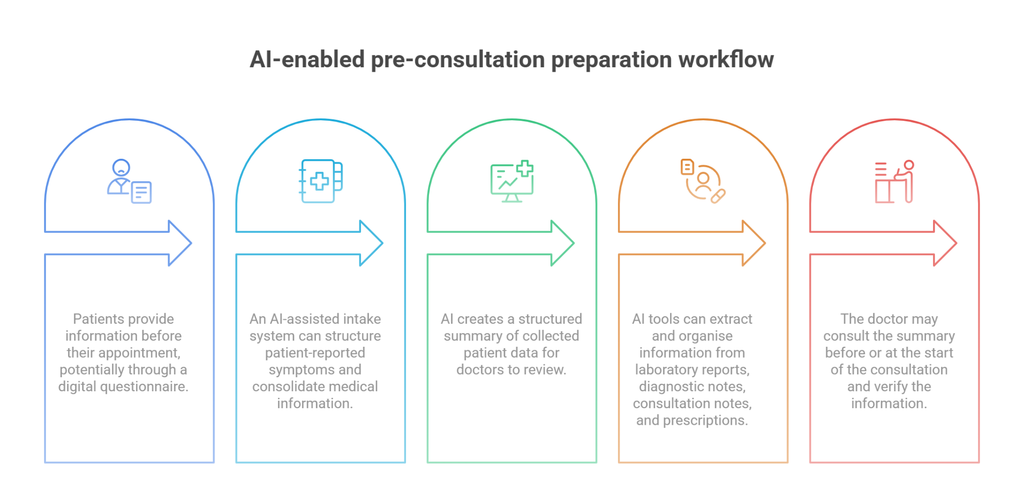
Typical AI-enabled pre-consultation workflows consist of gathering patient data, structuring the information submitted, and preparing a summary for clinicians’ review.
This will depend on the platform and what it can do.
1. Collecting patient information before appointments
This first step is to gather information from patients prior to their appointment with the doctor.
Depending on the system, there may be a digital questionnaire to be completed by patients, which includes questions on:
- The purpose of their visit to the clinic.
- Any current symptoms and the time of onset.
- Existing health conditions.
- Past surgeries and medical treatments.
- Medications currently taking and known allergies.
- Appropriate medical reports or prescriptions.
This may decrease the number of times your patient has to fill out background information.
The questionnaire should be tailored to the nature of the consultation and easy to understand for patients with varying levels of medical understanding for clinics.
2. Organizing patient symptoms and medical histories
Patients may not use medical language to describe their symptoms, but rather use conversational language.
A patient may say, for instance:
- I have been dizzy for the past two weeks, particularly when I get up.
- This statement might be helpful to structure with the help of an AI-assisted intake system, such as the reported symptom, duration, and circumstances in which the symptom occurs.
- It can also consolidate information regarding drugs, past conditions, and prior medical consultations.
This can facilitate doctors’ access to patient-reported information in this structure.
The system should, however, maintain the original description and not make any assumptions about the diagnosis from the description alone.
3. Creating structured patient summaries
AI can be used to create a summary of patient data collected, which could be useful in healthcare.
Doctors can be given a structured overview of key patient-reported information instead of a whole questionnaire.
The pre-consultation summary may consist of:
| Information | Details Included |
| Chief complaint | The primary purpose of the consultation.The major objective for the consultation. |
| Symptom history | Symptoms, length and course of illness. |
| Medical history | Existing medical conditions |
| Medication history | Prescribed or recently used drug(s) |
| Allergies | Any known or reported allergies. |
| Previous investigations | Relevant diagnostic reports |
| Follow-up questions | Information that is missing or not clear. |
In a 2025 study published in PLOS Digital Health, researchers evaluated AI-generated summaries of 100 adult emergency department encounters. Among the summaries generated by GPT-4, 47% omitted clinically relevant information. The study examined emergency department documentation, not outpatient intake, but it illustrates why doctors should be able to check a draft summary against the patient’s original answers and records.
It aims to assist doctors in navigating available information (but not to determine the significance of the information without human review).
The physician should access the patient’s original answers and correct any inaccuracies.
4. Reviewing medical documents
Patients are able to submit laboratory reports, diagnostic notes, and previous consultation notes as well as prescriptions.
There are AI tools for doctors that can help them extract and organize information from these documents.
A system could, for instance, organize laboratory results by time, or search for information from uploaded prescriptions.
This could make it easier to review records if a patient has several records.
However, AI can misread documents, miss information, or miss details when scanning documents. It is essential that important findings are confirmed with the original records by the clinician.
5. Preparing doctors for patient conversations
Once information has been gathered and organized, the doctor may consult the summary prior to or at the start of the consultation.
This can be useful in finding questions to address.
For instance, the summary can state that medication is being taken but not the dosage.
The doctor can then explain this information directly.
AI can aid in preparation by providing information in a more accessible format. The doctor is responsible for verifying the information and its clinical relevance.
What Are the Benefits of AI-Powered Patient Intake for Doctors?
For clinics that have to gather a lot of patient data, AI-driven patient intake could be a useful practical advantage.
The real benefits will depend on the accuracy, ease of use, and clinical workflow integration of the software.
1. Better-organized patient histories
A patient intake process with a structure can integrate relevant patient information in a structured way.
It’s easier for doctors to comprehend the patient’s reported concerns if symptoms, medications, and medical history are given together.
This can be especially helpful when following up with the doctor or if you have several medical reports to review during a consultation or appointment.
2. Reduced repetitive administrative work
Digital intake can help to minimize the need to gather repetitive data or manually copy and paste data from paper questionnaires.
Reception staff and clinical teams might be able to see previous information that has been submitted, rather than gathering it again.
But this administrative convenience needs to be assessed in practice, as badly designed systems can generate new verification tasks.
3. More focused doctor-patient communication
If patient information is available prior to the appointment, doctors can start with an initial understanding of what the patient has reported as they are concerned about.
This may help to get to the point of discussing the symptoms that need further clarification, any pertinent exam findings, and the next steps.
Importantly, a structured summary should not be taken to replace listening to the patient or taking a clinically appropriate history.
4. Improved organization of follow-up information
If a patient is seen for multiple visits and has multiple prescriptions, investigation reports, etc., they may have multiple records.
A digital workflow can assist in keeping previous information organized and better detect changes between visits.
This relies on good documentation, proper authorization, and good data control.
5. More consistent information collection
Clinics can gather key information more consistently by using standardized questionnaires.
For instance, a clinic might have a protocol to ensure that the medication is discussed, allergies are sought, and relevant health issues are discussed.
AI can also help to organize responses and detect missing sections.
But regular collection does not ensure complete or medically accurate information. Follow-up questions need to be asked by the clinician, of course.
AI-Assisted Patient Intake vs Traditional Patient Intake
AI-Assisted Patient Intake is a game-changer for any healthcare practice. AI-Assisted Patient Intake has revolutionized healthcare practices.
The main difference between an AI-assisted workflow and a traditional workflow is how patient information is gathered, handled, and displayed.
| Area | Traditional Patient Intake | AI-Assisted Patient Intake |
| Patient details | Paper forms or verbal questions | Online questionnaires and led intake session |
| Medical history | Gathered at the consultation | May be collected before the appointment. |
| Symptom documentation | Manually recorded | Can be organized from patients’ answers |
| Medical records | Reviewed individually | May be digitally organized or summarised |
| Consultation summary | Prepared manually | The draft, created by the AI, is for clinician review. |
| Missing information | Identified during questioning | May be highlighted prior to consultation |
| Clinical decisions | Made by the doctor | Remain with the doctor |
It is not necessary to have an AI system for all electronic forms.
Basic digital systems are already effective at collecting patient information. AI can bring value when it offers reliable summarisation, information organization, or other useful abilities that enhance the current digital processes.
Example: How AI Can Support a Doctor in an Indian Clinic
Let’s take a hypothetical example of a general physician working in a clinic in Bengaluru.
A patient comes in for regular complaints of headache and tiredness. The patient has had a blood test performed before and has been prescribed medicine for an existing medical condition.
A typical process would involve the doctor taking the patient’s history at the appointment, reviewing reports, and ensuring the patient understands the medications.
The process may be different with an appropriately designed pre-consultation system supported by AI.
- Prior to the consultation: The patient completes a digital questionnaire about symptoms, available medical history, and any medications taken. Any medical reports are uploaded, where relevant.
- During information processing: Organizes the answers and generates a summary with reported symptoms, previous conditions, medication information, and references to uploaded reports.
- Before encountering the patient: The physician reviews the summary and determines what is missing.
- During the consultation: Physician verifies information, asks additional questions, conducts the appropriate examination, and determines the investigations or treatment.
In this case, AI is used for information preparation instead of medical assessment.
The scenario is an example of workflow and not a guaranteed clinical result or an actual DocForUs deployment.
What Should Indian Doctors Consider Before Using AI Tools?
Adopting AI into a clinical workflow is more than software selection.
Any system that is to be used should be evaluated for reliability, availability, and data-handling mechanisms by doctors and clinic owners.
Clinical accuracy and human oversight
The Indian Council of Medical Research’s 2023 ethical guidelines on AI in healthcare state on page 21 that “AI for health should always be appropriately supervised.” For pre-consultation intake, that means doctors should be able to review the original patient answers and uploaded reports, correct the draft summary, and verify clinically important details before relying on it.
AI-provided summaries may lack information, contain misinformation, or be misinterpreted.
Doctors should be able to see what information was used as a source, correct any inaccuracies, and decide whether a summary is suitable for clinical use.
It should not make any final diagnoses or treatment decisions without user input.
Patient data privacy
Patient history, prescriptions, and diagnostic reports may contain sensitive personal information.
Clinics should consider how an AI platform collects, processes, stores, and shares this data.
Access controls, data retention, patient notices, consent (where applicable and required by Indian data protection requirements), etc., are key points.
Vendors must have supporting documentation for security and regulatory compliance claims.
Compatibility with existing clinic workflows
Ability to integrate with current clinic processes.Integration with existing clinic workflows.
AI tools should enhance, not complicate, the clinic’s workflow.
Doctors need to consider how a platform fits into current registration procedures, appointment systems, and patient records.
Patient accessibility
Not all patients can fill out forms online.
When designing the intake process, clinics should be mindful of patients who may not be as technologically literate, have a disability, cannot read the language of the website, or have poor internet connectivity.
A digital questionnaire should not be an obstacle for someone who requires immediate medical care to get an assessment.
Measuring practical outcomes
Clinics can determine if the system is useful before expanding its implementation.
Possible measures include:
- The rate of patient questionnaires completed.
- Frequency of errors in AI-generated summaries.
- The number of days clinicians need to review and edit information.
- Patient or staff comments.
- Changes in administrative workload.
These steps help clinics determine the practicality of these tools without assuming that AI tools automatically improve clinical performance.
How Can DocForUs Help Doctors Prepare Before Consultations?
DocForUs is an AI-driven healthcare platform to make doctors’ preparation of patient information easier before consultations.
Any published positioning of the platform focuses on acquiring patient data, structuring medical records, and submitting structured information for clinical review.
Its planned approach is to assist doctors with pre-consultation preparation and to ensure that qualified individuals make medical decisions and that qualified medical professionals provide patient care.
DocForUs is not intended to take the place of the doctor-patient relationship; it simply seeks to make relevant information easily accessible and reviewable.
For doctors who want to know more about the platform, they can go on and take a look at the DocForUs solution for doctors.
Features, integration options, and clinical validation are subject to change and will be known only to a private beta of DocForUs.
Interested in learning about the AI-powered patient consultation preparation?
To learn more about the platform and to request access, visit the DocForUs private beta page.
Will AI Replace Doctors in Patient Consultations?
AI will not render the need for well-trained doctors in patient consultations void.
Medication involves knowing the symptoms, interpreting the findings, examining patients, weighing the evidence, and making decisions based on individual circumstances.
These duties go beyond the mere gathering of information or automatic summarisation.
AI can assist with specific administrative and clinical information management tasks but needs to be reviewed appropriately.
There will be no change in the role of doctors for diagnosis, treatment plans, and decisions to care for the patient.
Organising information with human oversight is the most likely area where AI can be integrated into the pre-consultation process.
Conclusion
For doctors, AI can be a practical solution for preparing for consultations by structuring patient histories, gathering information in advance, and providing a summary of the material to review.
These features can help overcome disjointed patient information and the need to repeatedly collect the same data and document administrative details in Indian clinics.
But successful implementation will rely on accurate information, secure data handling, accessible workflows, and appropriate clinical control.
Frequently Asked Questions About AI for Doctors
1. How can AI help doctors prepare before patient consultations?
AI can help doctors prepare by collating patient-reported data, structuring medical records, analyzing incoming documents, and creating concise summaries. These summaries can help the doctor understand the patient’s background before the appointment. But the clinician should confirm the information and remain responsible for making medical decisions.
2. Can AI collect patient medical history before an appointment?
Yes. Some AI-enabled patient intake systems use digital questionnaires to gather symptoms, medication information, allergies, and previous medical history before appointments. The information can be organized for clinicians to review, but doctors should verify important details with the patient themselves.
3. What are the benefits of AI-powered patient intake for Indian clinics?
Potential benefits include better-organized patient information, less repetitive data collection, more consistent documentation, and improved consultation preparation. The real benefits will vary based on the software’s reliability, usability, accessibility, and compatibility, as well as how it fits into existing clinic workflows.
4. Can AI summarise medical reports and patient records?
Certain AI healthcare solutions can analyze and synthesize data from medical records, such as laboratory reports and prescriptions. But AI-generated summaries may miss information or be inaccurate. Doctors must verify clinically important information from original documents to make medical decisions.
5. Is AI safe for doctors to use with patient information?
AI tools can be used responsibly when supported by appropriate security controls, data-handling policies, clinical oversight, and applicable regulatory safeguards. Doctors should consult vendor representatives to confirm their claims, and AI output should be reviewed before it is used in clinical practice.