

TL; DR:
The blog explains how digital patient intake replaces traditional paper-based forms and repetitive verbal questioning with electronic questionnaires, online registration, and structured patient records that doctors can access before or during consultations.
- Learn the step-by-step digital patient intake process: Readers discover how patients can book appointments, complete digital questionnaires, submit symptoms and medical histories, upload relevant medical reports, and provide information that doctors can review before consultations.
- Explore the benefits of digital patient intake for Indian clinics: The article highlights how digital intake can reduce repetitive registration tasks, improve medical record organization, support more consistent documentation, enhance patient convenience, and help doctors prepare for more focused consultations.
- Understand the role of AI and implementation considerations: The blog explains how AI-powered intake systems can organize patient responses, structure medical histories, and generate consultation summaries. It also covers patient data privacy, clinical verification, digital accessibility, staff training, and integration with existing clinic workflows.
- Discover how DocForUs supports digital patient intake: The blog introduces DocForUs as an AI-powered healthcare platform designed to collect patient information, organize medical histories, and prepare structured summaries for doctors. It highlights the platform’s proposed approach to improving pre-consultation preparation while keeping clinical decisions and patient care under doctors’ supervision.
One patient comes to a clinic to see their doctor. They will have to fill out a registration form before going to see the doctor; they will have to describe their symptoms, their medical history, and any medications they are taking.
This information is captured in many Indian clinics using paper forms, verbal questioning, or manual data entry. Patients can re-enter the same information to reception, nurses, and doctors, and important records are spread across prescriptions and reports.
Digital patient intake streamlines the process of data collection and organization of patient information before or during the appointment.
Clinics can eliminate the tedious process of filling out handwritten forms and manually recording information by using online questionnaires, electronic registration systems, and structured digital records.
This can make relevant patient information more readily available before a consultation for doctors.
It outlines the definition and functioning of digital patient intake, its advantages, and how this feature can be incorporated into the current patient intake processes in Indian healthcare environments.
What Is Digital Patient Intake in Healthcare?
A digital patient intake refers to the act of capturing patient data and information, such as medical history, symptoms, among others, electronically, instead of entirely from paper forms or verbal records.
Information can be gathered via online forms, patient portals, tablets, mobile applications, or digital questionnaires.
A digital patient intake system can help with several activities such as:
- Gathering patient and contact details.
- Documenting symptoms and why patients are visiting.
- Obtaining patient history and current health issues.
- Taking a list of the medications and allergies someone is currently taking.
- Being provided with medical reports where relevant.
- Arranging information for the authorized clinic staff and doctors.
Certain systems also feature AI-powered features for summarising patient answers or structuring data for clinical assessment.
But simply using the internet to get a patient to fill out paperwork does not automatically mean it’s a digital patient intake system. There are already forms available online that allow patients to register, and this is a basic example of digital intake.
The ultimate goal is to simplify patient information collection, management, and retrieval in the clinical workflow.
In August 2026, the National Health Authority reported that the Ayushman Bharat Digital Mission’s QR-based Scan and Register service had crossed 25 crore outpatient registrations. At participating facilities, patients can scan a QR code and share their Ayushman Bharat Health Account (ABHA) profile with consent to register digitally. This is an Indian example of digital registration, which is one part of patient intake. It does not measure how many patients completed a medical history or uploaded reports.
Why Is Digital Patient Intake Important for Indian Clinics?
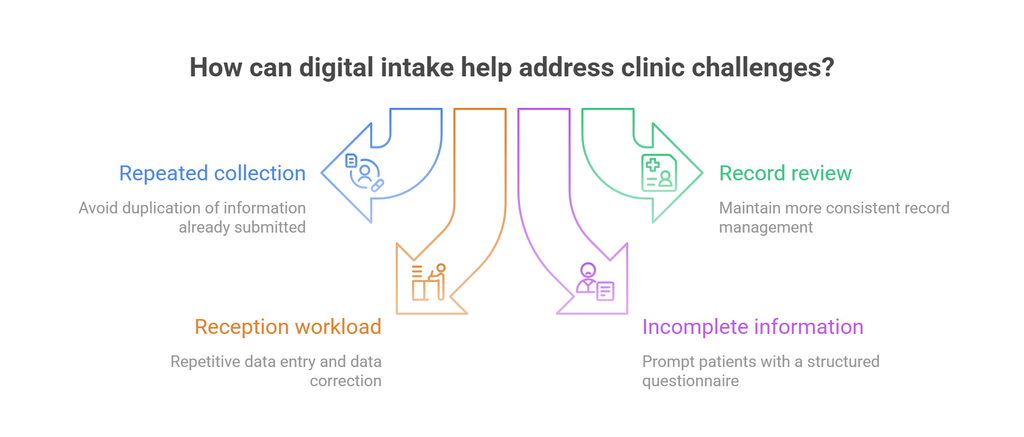
The extent of the digital infrastructure in healthcare practices around India varies.
Some clinics have electronic medical records and scheduling systems, and others do not have electronic records but have paper-based patient files and handwritten patient records.
Either way can be used for clinical care; manual collection of information can lead to unnecessary administrative burdens.
Repeated collection of patient information
During registration and at the initial consultation, patients can enter their personal information and provide medical information on repeat.
If records are hard to find, they may need to be gathered again for returning patients whose records will already have been obtained.
The digital intake can assist in streamlining information that was already submitted and avoid duplication.
Difficulty reviewing previous medical records
Patients frequently have multiple healthcare provider prescriptions, investigations, and treatment records that they carry with them.
If this information is not structured, physicians could have to rely on a couple of documents during a consultation.
When information is structured, a digital system can help maintain more consistent record management, especially in terms of the information that is relevant.
Administrative workload at reception
Reception staff can be involved in registration, booking appointments, completing forms, and updating patient records.
Manual methods involve repetitive data entry and data correction.
While some tasks might be made easier with electronic intake, the success will rely on how easy and effective the system is to use and how well it fits with the current clinic workflow.
Incomplete patient information
Patients can forget the names of the drugs, earlier diagnoses, or information from previous appointments.
Patients may be prompted to give relevant information before they start the interview by using a structured questionnaire.
But digital forms can’t ensure 100 percent or 100 percent accurate responses. Now, there are many things that doctors have to confirm clinically important details.
How Does the Digital Patient Intake Process Work?
A digital patient intake process typically starts before the appointment and stays in process until patient information is ready for clinical review.
Appointment booking
Patient schedules a consultation with Dr. Zouma. Patient makes an appointment to see Dr. Zouma.
Digital questionnaire
Patient shares symptoms and medical history
Information organisation
Any information submitted is kept and organized.
Doctor review
Clinician checks information before or during the consultation
Step 1: The patient books an appointment
The process can start when a patient books their consultation online, over the phone and/or from the clinic reception.
If the clinic has the ability to accept pre-visit forms, the patient can be asked to bring along any relevant information prior to arrival at the clinic.
This allows patients to give information without the added time pressure of completing forms at the reception.
Step 2: The patient completes a digital intake form
Patients may be asked to fill out a questionnaire regarding the reason for their visit, symptoms they have experienced, previous illnesses, current medications, and allergies.
For instance, a general doctor’s screening form could include:
- Which of your top health issues do you have?
- How long have you had your symptoms?
- Do you have any medications that you are currently on?
- Ever been treated for this condition before?
- Are there any allergies you know of?
- Do you have any relevant medical reports?
Questions should be clinically relevant and easy to understand.
A good form should also give patients the option of saying that they don’t know the answer.
Step 3: Patient information is organized
Once submitted, it is entered in the clinic’s electronic records.
The software can organize responses in categories like symptoms, medical history, medications, and past investigations.
Prescription or laboratory reports can also be uploaded in some systems, enabling patients to submit them to the system.
Access must be limited to authorized users, and sufficient privacy and security measures must be put in place.
Step 4: The doctor reviews the information
The doctor can consult the information that the patient has given him before or during the appointment.
This can assist in uncovering missing information, past illnesses, or issues to be resolved.
If there is AI-assisted summarisation, the AI system can create a summary of the text submitted.
But the doctor should check the details of the digital record or AI-generated summary for clinically significant information, not simply take it on faith.
Step 5: The consultation takes place
The physician verifies patient information from relevant sources during the consultation, records all additional patient information, conducts the physical examination, and decides on any further measures.
Digital intake is used to assist in the preparation process, but not to replace the consultation itself.
Diagnosis, treatment plan, and patient care are the responsibilities of the clinician.
What Information Should a Digital Patient Intake Form Collect?
The data gathered should be related to the kind of consultation and the clinic’s clinical needs.
The following categories can be on a general intake form:
| Information Category | Examples |
| Patient identification | Name, age or date of birth, relevant patient identifier |
| Contact details | Contact information (phone number, preferred method) |
| Appointment details | The department, doctor, and reason for visit should be specified. |
| Presenting complaint | Current symptoms and their duration. |
| Medical history | Any current or prior medical history and treatments |
| Medication history | Up-to-date drugs and doses |
| Allergies | Relevant clinically significant allergies to known drugs or other drugs. |
| Previous investigations | Any medical, blood tests, or scans that are relevant. |
| Consent and notices | Information about data collection and use |
But, even if it is possible, a digital form shouldn’t be the reason clinics collect information.
Details should only be requested as pertinent to intended clinical and administrative use.
Specific forms for each specialty may ask other questions. An orthopedic consultation might require information on pain, injury, and mobility, whereas a diabetes follow-up might be concerned with current diabetes medication and recent investigations.
What Are the Benefits of Digital Patient Intake for Doctors?
The following are some of the ways digital patient intake can help with clinic operations and preparation for consultation.
1. More organized patient information
Electronic forms present information in a consistent format.
When information is organized into meaningful sections, doctors will be able to examine the symptoms, medication history, and past conditions.
2. Less repetitive registration work
If patients provide information beforehand, the reception staff does not have to enter all the details at check-in.
This can cut down selected administrative tasks so long as the digital system performs effectively and the data reported is correct.
3. Better preparation before consultations
Patient-reported information can be made available before the appointment via digital intake.
It can be used by doctors to help them find out what they do not understand or what documents they should look at.
This can assist in more targeted preparation, but it is still important to have an appropriate clinical history.
4. More consistent record organization
Clinics can gather pertinent information through a standardized procedure with the use of standardized intake forms. This can facilitate record keeping and help with some information being easier to access in future appointments.
5. Improved patient convenience
Some patients might be at ease filling in forms online prior to their appointment.
It can allow them to review medication lists, find pertinent reports and information, and provide information more carefully.
Clinics should continue to provide a suitable alternative for patients who are unable or unwilling to complete online forms.
Digital Patient Intake vs Traditional Paper-Based Intake
Both traditional patient intake and digital patient intake can aid in the provision of clinical care. The primary differences between them are in the way information is collected and handled.
| Feature | Paper-Based Intake | Digital Patient Intake |
| Registration | Handwritten forms | Electronic forms |
| Medical history | Paper questionnaire or verbal collection. | Structured digital questionnaire |
| Information storage | Physical patient files | Digital records |
| Record retrieval | Manual file search | Searchable records (if available) depending on system |
| Data correction | Manual updating | Electronic editing, with proper controls in place. |
| Document collection | Physical copies | Digital uploads – where possible |
| Information sharing | The final two options are physical transfer or manual entry. | Controlled electronic access |
| AI-assisted summaries | Not typically available | It is likely to be possible in the systems where AI techniques are applied. |
Not all the time is digital intake better.
For patients with accessibility requirements, limited connectivity, or challenges in using digital devices, paper-based processes might be needed.
Clinics should choose those that will allow safe and equitable access to care.
What Is the Role of AI in Digital Patient Intake?
There is a difference between digital patient intake and AI patient intake.
A traditional digital intake system gathers and keeps patient data on electronic forms.
Another feature that an AI-powered system can offer is the ability to analyze free-text answers, structure healthcare information, and create a summary for the clinician to review.
AI-assisted patient questionnaires
Some systems may lead the patient through a question set based on information given by the patient.
If the patient complains about a symptom they have noticed before, for instance, the length of time that it has been present, or how often it occurs, or whether there are other issues related to it.
These questions should be followed by an appropriate process that is designed and clinically reviewed.
Structured patient summaries
AI can help to organize lengthy patient responses into concise summaries.
A physician might get an overview of all the patient-reported symptoms as well as get all of the patient’s conditions and drugs without checking each answer separately.
These synopses need to be modifiable and traceable back to the original text.
Medical document organization
Medical information could be extracted and organized using AI systems, such as those for uploaded files.
But automated processing can be wrong, particularly if the documents have unclear text, abbreviations, or complicated medical language.
Further clinical proof is required.
Supporting doctors rather than replacing them
AI intake should be used as a tool for information management but not as a source of medical decisions.
Doctors need to identify the information that is relevant, to ensure that this information is accurate, and then to assess the patient through suitable clinical procedures.
Practical Example: Digital Patient Intake in an Indian Clinic
Assume that there is a hypothetical general practice in Pune.
A patient has a recurring complaint of abdominal pain.
In a paper-based workflow, the patient could fill out a registration form at reception and give details of symptoms during the consultation. The doctor may also need to have a look at previous reports and prescriptions.
If the patient intake system is digital, then a different workflow can be used.
The clinic uses a secure digital questionnaire that is sent to the patient prior to the appointment.
The patient provides information about the symptoms, their duration, previous medical conditions, and current medications.
The patient also provides relevant reports in the system, which are supported.
The information is organized into a structured record.
The doctor reviews the information and formulates questions for discussion during the consultation.
The doctor confirms the information during the appointment, does the required examination, and determines the right clinical next steps.
The digital process makes it easier to organize the information before the visit and to keep the doctor responsible for the medical assessment.
This is an example of a workflow and not a verified DocForUs clinical case study.
How Can Indian Clinics Implement Digital Patient Intake?
A new digital intake system must be planned in light of current clinical processes, staff roles, and patient needs.
1. Review the current patient registration process
First, know how information is gathered and preserved.
Recognize repetitive tasks, delays in obtaining records, and information that patients often have to provide more than once.
2. Choose relevant digital intake features
A small practice may only need electronic registration and a set of medical history forms, which are structured.
For more sophisticated applications, document management, appointment system integration, or AI-generated summaries could be helpful.
Selected features should be relevant to current workflow requirements.
3. Design clear patient questionnaires
Questions need to be easily understood and clinically relevant.
Don’t use unnecessary medical jargon or complicated forms that patients may have difficulty filling out.
Clinics, especially those with multilingual populations, should determine the availability of appropriate language support.
4. Establish patient data protection practices
Clinics need to be aware of the processes and security the software puts in place when accessing patient information digitally.
Security access, patient notices, consent requirements, retention, and security incident response policies and procedures are important factors to consider.
Clinics should review their obligations with respect to Indian data protection obligations and seek professional advice accordingly.
5. Train clinic staff and doctors
Reception staff should have an understanding of how to support patients and be able to recognize when forms are incomplete and deal with registration exceptions.
Physicians should be aware of how to evaluate submitted data and rectify errors found.
If a summary generated by AI is relied upon, it is important that clinical teams are aware of the limitations of the system.
6. Monitor the results
Once implemented, clinics can measure the percentage of questionnaires completed, feedback from staff, percentage of corrections needed, and patient feedback.
The aim should be to see if the system actually helps to manage information and not interfere with clinical care.
How Does DocForUs Support Digital Patient Intake?
DocForUs aims to create an AI-powered healthcare platform based on preparing patient information for medical appointments.
Its published product information says that DocForUs is targeted at digital intake, structured patient history, and AI-based history summaries that can be reviewed by clinicians.
It promises to gather patients’ first complaints, organize medical information, and provide data relevant to the complaints before patients’ visits.
This moves away from collecting all patient information at the time of consultation and instead moves to preparing information earlier in the clinical workflow.
Doctors and clinic owners may benefit from having patient-reported data in one place for easy reference.
In addition, DocForUs outlines more general AI-driven features such as report analysis and clinical information support. These features should be tested in the product for availability and validation.
Doctors can use the DocForUs solution to get a sense of how the platform will be used in clinical practice.
The platform also has private beta access, so clinics should contact the DocForUs team to confirm functionality and deployment requirements and data protection documentation.
Looking to implement digital patient intake with AI assistance in your clinic?
Head to the DocForUs private beta page to see why and to request early access to the platform.
What Challenges Should Clinics Consider Before Switching to Digital Patient Intake?
While digital patient intake can enhance information organization, there are implementation challenges to consider.
India’s 2025 Comprehensive Modular Survey on Telecom found that 83.3% of rural households and 91.6% of urban households had internet access within their premises. Household access does not tell a clinic whether an individual patient can complete a form independently. Offer a mobile-friendly form where possible, and keep a staff-assisted or paper option for patients who need it. mospi.gov.in
- Inaccurate responses: There may be inaccuracies in responses to electronic forms; even with incomplete information, misinformation about medicines may be present.
- The integration of systems: A digital intake platform may require extra effort to be integrated with the current appointment and patient record system.
- Data privacy: The information of patients should be treated responsibly, ensuring proper security measures and access restrictions.
- Clinical verification: Data gathered electronically cannot be assumed to be correct.
Clinics should have an alternative method of intake for their patients if they are unable to complete the digital intake process, and make sure that urgent care is not placed on hold because of administrative needs.
Conclusion
Indian doctors and clinics can manage patient information by organizing and centralizing it and making it accessible to them via digital patient intake.
Clinics can streamline patient-reported data and cut down on repetitive documentation by transitioning certain registration and medical history collection processes into a digital workflow.
This process can be prolonged with the assistance of AI technology, which can organize information and generate summaries, as long as the results are accurate and verified by experts.
The technology should facilitate the clinical workflow, not replace patient communication, medical examination, or professional judgment, however.
A first step in Indian clinics looking to implement a digital transformation is to determine the existing problems with information collection and choose a system that can solve these problems without compromising patient information security or accessibility.
Frequently Asked Questions About Digital Patient Intake
1. What is digital patient intake in healthcare?
Digital patient intake is the electronic gathering of patient data prior to or during medical visits. This can contain registration information, symptoms, medical history, treatments, and pertinent medical records. Clinics employ digital forms or patient intake systems to structure data and provide access to authorized healthcare personnel.
2. How does digital patient intake benefit doctors?
Having a digital patient intake can enable doctors to access structured patient histories, review reported symptoms, and determine missing information prior to consultations. It could also decrease frequent administrative tasks and aid in maintaining uniform documentation. Doctors will need to confirm key information, though, and will need to be clinically aware.
3. What is the difference between digital patient intake and AI patient intake?
Digital patient intake involves the use of digital forms and systems to gather and preserve patient details. AI patient intake can also process free-text answers, categorize medical histories, or create a medical summary. Different platforms offer different levels of AI functionality, and humans must review all clinically relevant inputs.
4. Can small clinics in India use digital patient intake systems?
Yes. Small medical practices can leapfrog paper-based patient registration with an electronic registration form or dedicated patient intake software, which includes online medical history questionnaires. The most appropriate solution will depend on the needs of the patient, the infrastructure, staff training, budget, and data protection needs.
5. Is digital patient intake secure for medical information?
With proper security measures in place, digital patient intake can be done safely. The doctors and counselors should consider issues like encryption, access control, data storage, retention period, and relevant Indian privacy laws. Security is dependent on the platform and how it is implemented, and any claim of compliance or protection should be confirmed prior to use.